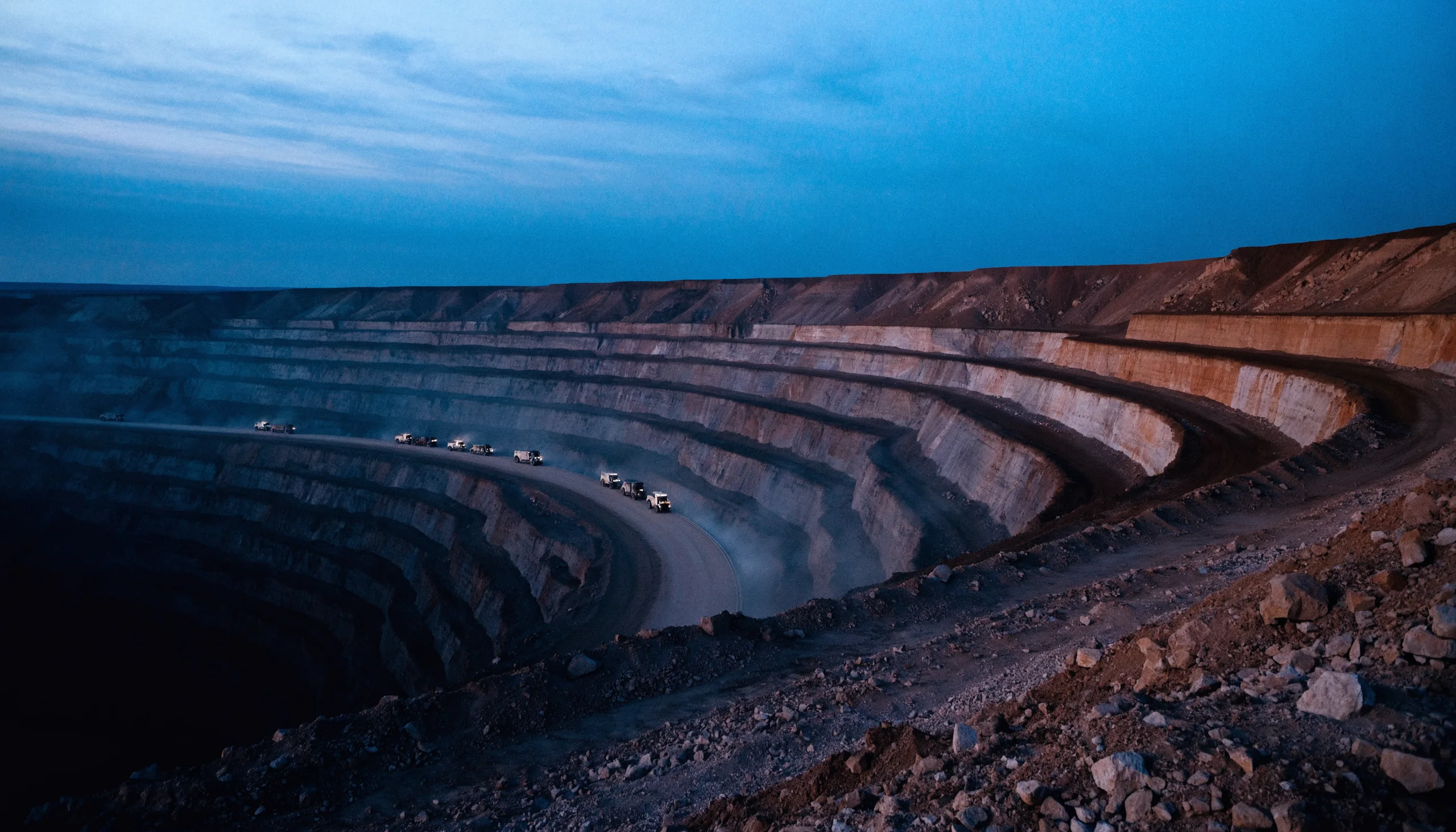
From the pit wall to the mill, with the ground, the water and the machines in one model.
Coupled geomechanics for slopes and tailings, process and thermal simulation for the circuit, and predictive intelligence on maintenance data that has been reconciled first.
- 01Rock and water together
- Displacement and pore pressure solved in one system, for pit walls through the wet season and tailings through the next raise.
- 02Tested before installation
- Discrete-element, CFD and thermal models that test a liner, a chute or a circuit change before the capital is spent.
- 03A cause with every forecast
- Forecasts for the mill's drives and pumps, with the mechanism and the confidence stated, on asset data reconciled across the mine's systems.
01Pain points
What we help solve
- 01
Slope stability assessed without the water
Pit walls checked with a limit-equilibrium model while groundwater is studied separately. Pore pressure sets the effective stress that decides whether a wall moves.
- 02
Tailings judged against static assumptions
A raise sequence changes loading, drainage and liquefaction susceptibility as it proceeds. Assessments that treat the facility as finished miss the states it passes through.
- 03
Circuit changes proven after installation
A liner profile or a transfer chute is judged once it is running and the capital is spent. DEM moves that trial in front of the decision.
- 04
Maintenance scores with no mechanism
A health score alone does not tell a planner what to inspect. With the mechanism stated, the planner knows what to open, and roughly when.
02Capabilities
Our work in mining
Coupled subsurface and plant physics, and operational intelligence from the pit wall to the processing circuit.
- Geomechanics and tailings
Displacement and pore pressure solved in the same system.
- Slope stability with dewatering, drawdown and rainfall as inputs to one model
- Tailings dam behaviour across a raise sequence, including liquefaction triggering
- Subsidence, backfill performance and closure behaviour over the life of the mine
- Process and equipment simulation
Flow, heat and particle mechanics used to test a change before it is built.
- Mill liners, transfer chutes and stockpile geometry tested in DEM before installation
- Kiln and furnace heat flux, including the refractory hot spots that decide campaign length
- Slurry lines: erosion hot spots and the geometry that reduces wear
- Operational intelligence
Mechanism-based forecasts, vision where a measurement is missing, and one asset identity under both.
- Failure forecasts with the mechanism stated and a calibrated confidence interval
- One asset identity reconciled across historian, maintenance system and engineering register
- Vision on froth, conveyors and haul roads where a measurement is what is missing
03Questions
Questions we take on.
01Will the east wall stay stable through the wet season at the planned dewatering rate?
02How will the tailings facility behave through the next two raises?
03Which of the mill's drive components will need attention before the next shutdown, and why?
04Solutions
Solutions we draw on
All solutions01Industrial AI
Industrial AI and automation
First-principles digital twins, forecasts with the reasoning attached, computer vision and autonomous systems for plants, fleets and cities, with the cause and the confidence shown next to every number.
02Simulation
Engineering simulation
Custom and open-source solvers for design, certification and optimisation. We cover fluids, structures, heat and electromagnetics, coupled where the physics is coupled, on infrastructure you control.
03Research
Scientific research and development
Model formulation, discretisation, convergence analysis, physics-informed learning and foundation models for simulation, built to run at industrial size.
04Software and HPC
Software engineering and HPC
Parallelisation, GPU kernels, simulation pipelines, testing and deployment for numerical software that has to run in production.
Contact