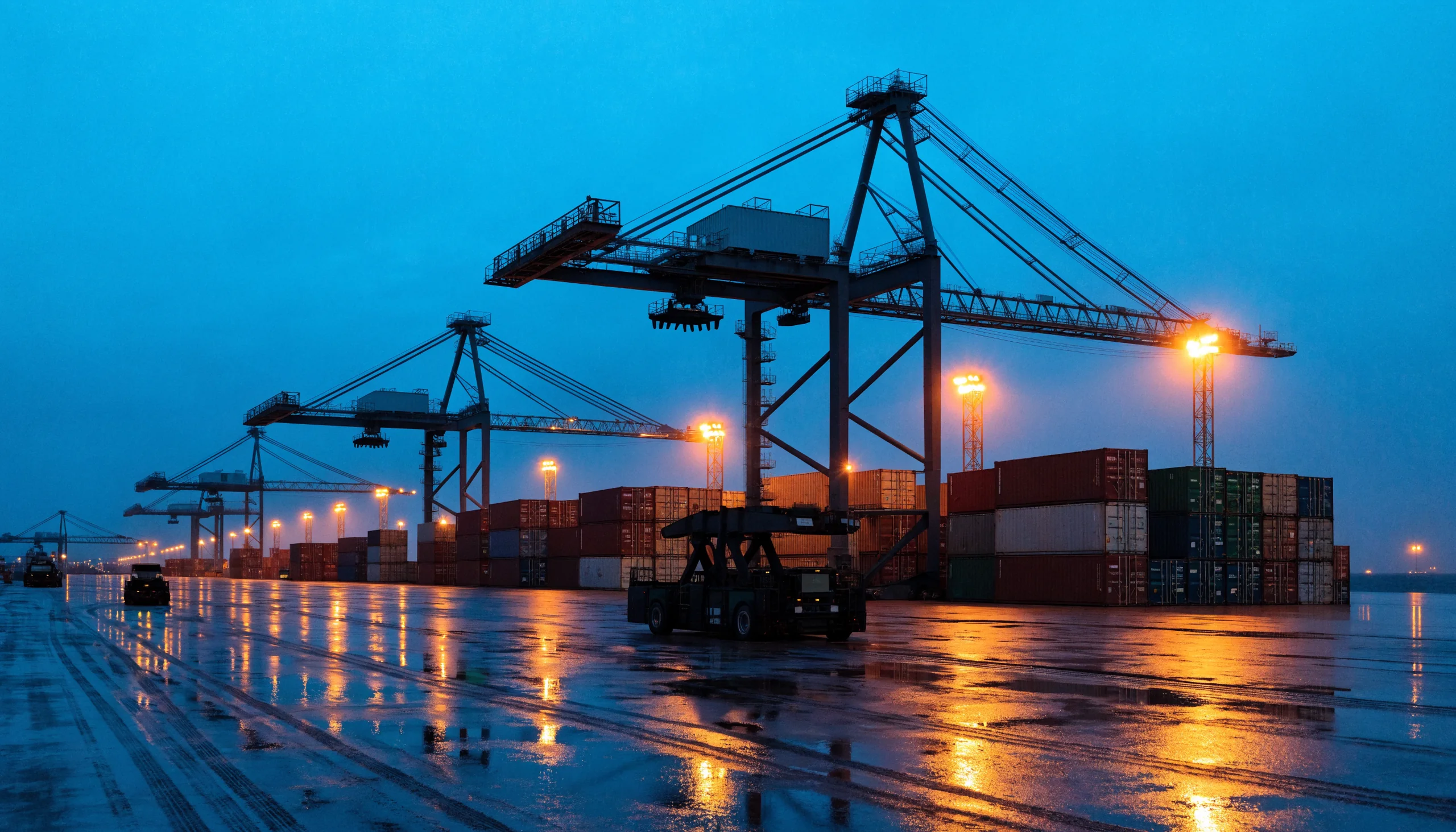
Dynamics, autonomy and traffic models a regulator can run again.
Vehicle and vessel dynamics, autonomy stacks on open robotics tooling, perception with validation, and city-scale demand modelled from first principles.
- 01Reproducible
- Dynamics, perception and control developed together and tested in simulation before hardware, documented so a person who did not build them can run them again.
- 02Certifiable autonomy
- Simulation evidence built for certification, on open tools you keep, validated against the hardware it controls.
- 03Traffic from first principles
- Demand modelled from the physics and economics that produce it, so the model can say what happens under a condition it has never seen.
01Pain points
What we help solve
- 01
No end-to-end simulation to audit
Dynamics, perception and control in separate tools, with no reproducible run a regulator can repeat.
- 02
Handling problems found on the track
Simplified models miss the coupling between aerodynamics, suspension and control until a prototype exists.
- 03
Traffic modelled as a statistic
Models fitted to historical counts cannot predict conditions outside that history.
- 04
Automation with nothing to test it on
Berthing, yard and vessel movements are planned in the terminal system, with no simulation to test automation against.
02Capabilities
Our work in mobility
The dynamics, the autonomy stack, the perception and the city model, each one inspectable.
- Vehicle and flight dynamics
How things move, modelled to the fidelity certification needs.
- Six-degree-of-freedom flight and vehicle dynamics
- Stability and handling across the operating envelope
- Hydrodynamics for marine vessels
- Aeroelastic coupling where it matters
- Autonomy and control
Built on open robotics tooling, validated against hardware.
- Simulation and prototyping on ROS 2 and Gazebo
- Guidance, navigation and control design
- Sensor fusion and state estimation
- Hardware-in-the-loop validation
- Perception
Vision with validation you can show a regulator.
- Computer vision for situational awareness
- Vessel and container tracking in ports
- Validation datasets and metrics you can defend
- Traffic and city-scale modelling
Demand from first principles, with the reasoning shown.
- Spatiotemporal demand modelled from the economics of the city
- Scenario planning that states its assumptions
- City-scale simulation for infrastructure decisions
03Questions
Questions we take on.
01Can our autonomous yard vehicles be certified on this site, and what simulation evidence will the authority want?
02How will the vessel handle at the new berth in a 25-knot crosswind?
03What does the new corridor do to demand across the city, and why?
04Solutions
Solutions we draw on
All solutions01Industrial AI
Industrial AI and automation
First-principles digital twins, forecasts with the reasoning attached, computer vision and autonomous systems for plants, fleets and cities, with the cause and the confidence shown next to every number.
02Simulation
Engineering simulation
Custom and open-source solvers for design, certification and optimisation. We cover fluids, structures, heat and electromagnetics, coupled where the physics is coupled, on infrastructure you control.
03Research
Scientific research and development
Model formulation, discretisation, convergence analysis, physics-informed learning and foundation models for simulation, built to run at industrial size.
04Software and HPC
Software engineering and HPC
Parallelisation, GPU kernels, simulation pipelines, testing and deployment for numerical software that has to run in production.
Contact